


Key Takeaways
The asking rent is only the starting point. What you actually pay depends on the building class, the lease structure, and how well the deal is negotiated.
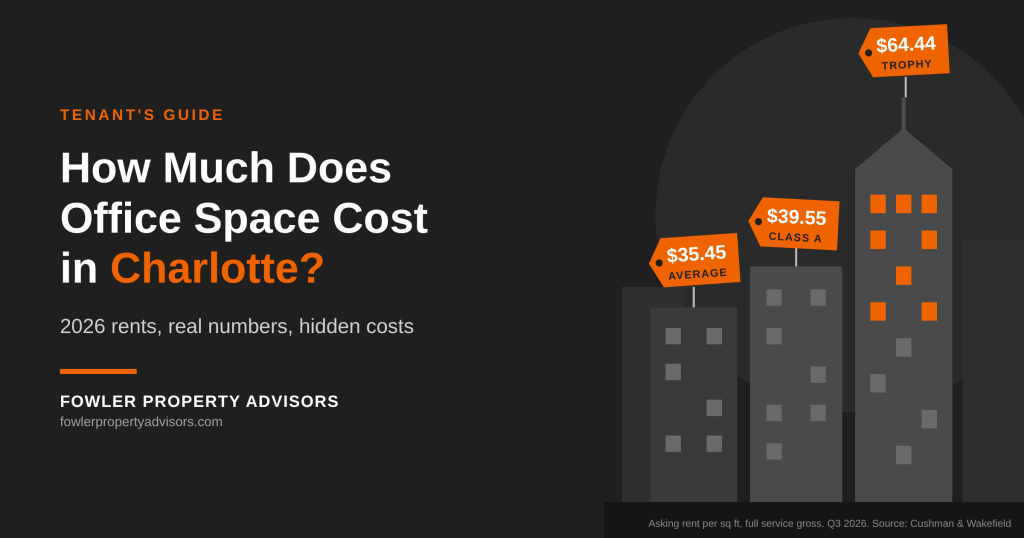
- Charlotte’s average office asking rent was $35.45 per square foot, full service gross, in Q3 2026, with Class A space averaging $39.55, according to Cushman & Wakefield.
- Trophy buildings are in a different price bracket. Cushman & Wakefield reported a record $64.44 per square foot for trophy space, a 50.2% premium over other Class A buildings in the urban core.
- Tenants still have leverage. Overall vacancy was 23.1% in Q3 2026 per Cushman & Wakefield (CBRE measured 22.0%), even after several quarters of improvement.
- Always ask how a rate is quoted. The market figures in this post are full service gross, and a triple net (NNN) quote on the same space can look very different on paper.
- Concessions such as free rent and a tenant improvement allowance can be worth more than a dollar or two off the base rent, and a tenant rep typically costs you nothing directly.
Every business owner who starts looking for office space asks the same first question: what is this going to cost?
It is a fair question, and the honest answer is that it depends. A 4,000 square foot suite in a SouthPark Class B building and the same footprint in a new South End or Uptown tower can be tens of thousands of dollars apart every year.
The listing flyer will give you an asking rent. That number matters, but it leaves out the lease structure, the annual increases, operating expenses, buildout costs, and the concessions a landlord is willing to give.
Here is what office space costs in Charlotte right now, what drives the price, and how to make sure you are comparing real numbers instead of marketing numbers.
What Is the Average Office Rent in Charlotte Right Now?
According to Cushman & Wakefield’s Q3 2026 Charlotte Office MarketBeat, the average asking rent across the metro was $35.45 per square foot per year on a full service gross basis, up 0.5% from the prior quarter. Class A space averaged $39.55 per square foot.
Those are full service gross rates, which means they generally include the building’s operating expenses, taxes, and insurance at the base-year level. More on what that means below.
At the top of the market, prices climb quickly. Cushman & Wakefield reported trophy asking rents at a record $64.44 per square foot, and CBRE reported that prime asking rents averaged $61.56 per square foot (full service gross) in Q3 2026, up 19.6% year over year.
In other words, most Charlotte tenants are shopping somewhere between the mid-$30s and the $60s per square foot, full service gross, and the gap between ordinary Class A and true trophy space is wide.
What Does That Mean in Dollars for a Real Office?
Office rent in Charlotte is quoted per square foot, per year. To estimate your annual rent, multiply the rate by the size of the space. Here is what a 5,000 square foot office looks like at the Q3 2026 full service gross averages.
| Rate type (Q3 2026, full service gross) | Rate per sq ft per year | Annual rent (5,000 sq ft) | Monthly rent |
|---|---|---|---|
| Metro average asking rent (Cushman & Wakefield) | $35.45 | $177,250 | $14,771 |
| Class A average asking rent (Cushman & Wakefield) | $39.55 | $197,750 | $16,479 |
| Trophy asking rent (Cushman & Wakefield) | $64.44 | $322,200 | $26,850 |
Because these are full service gross asking rates, they generally include the building’s operating expenses at the base-year level. Your final number will still move with escalations, expense increases above the base year, parking, and whatever you negotiate.
Rent also goes up every year in most leases. On that same 5,000 square foot space at $35.45, a 3% annual escalation takes rent from $177,250 in year one to roughly $199,500 in year five, and the five-year total comes to about $941,000. The escalation rate is one of the most valuable terms to negotiate.
Is the Rent Full Service or Triple Net?
This is the first question to ask about any quoted rate, because it changes what the number includes. The market averages in this post are all full service gross, but individual listings, especially for flex, medical, and some suburban space, may be quoted triple net.
A full service (or full service gross) rate typically bundles base rent with the building’s operating expenses, taxes, and insurance. A triple net (NNN) rate covers base rent only, and you pay your share of taxes, insurance, and common area maintenance on top of it.
In many leases, those pass-through costs show up as TICAM, which stands for taxes, insurance, and common area maintenance. If you are comparing a full service quote against a triple net quote, you need to add estimated TICAM to the NNN number before the comparison means anything. Our guide to TICAM in a commercial lease explains how those charges are calculated and how to cap them.
Good to Know: Even a full service lease usually has a “base year.” If operating expenses rise above that base year, the increase is passed through to you. Ask what the base year is and what expenses have done over the last few years.
Why Is Some Charlotte Office Space So Much More Expensive?
Three things drive most of the price difference: building quality, location, and demand.
Building class. Newer, amenity-rich Class A and trophy buildings command the highest rents. Cushman & Wakefield reported trophy vacancy at just 3.9% in Q3 2026, which is why those landlords can hold firm on price. If you are not sure what separates the classes, see Class A, B, and C commercial real estate.
Location. Uptown and South End, which Cushman & Wakefield groups as the urban core, carry a premium for walkability, transit, and amenities. Suburban submarkets such as Ballantyne, University City, and the airport area often offer more space and easier parking for the money, though pricing varies building by building.
Demand. The market is tightening. Cushman & Wakefield reported roughly 350,000 square feet of positive net absorption in Q3 2026, and CBRE reported 456,000 square feet, its fourth consecutive quarter of gains. Recent commitments include American Express taking nearly 98,000 square feet at Legacy Union and Huber Engineered Woods leasing about 51,500 square feet at Savona Mill.
Are Office Rents in Charlotte Going Up or Down?
Both, depending on where you look.
Top-tier space is getting more expensive. CBRE reported that prime asking rents rose 19.6% year over year, and overall asking rents rose 3.9% quarter over quarter in its Q3 2026 data.
At the same time, vacancy remains elevated by historical standards. Cushman & Wakefield measured overall vacancy at 23.1% in Q3 2026, down from a peak of 25.9% in Q2 2025. CBRE measured 22.0%. The firms track slightly different inventories, but the direction is consistent: vacancy is falling and the best buildings are filling first.
For tenants, that means the window for strong concessions in commodity Class B space is still open, while the most sought-after buildings are getting harder to negotiate. For a deeper look at where the market is headed, see our Charlotte office market forecast.
What Costs Are Not Included in the Asking Rent?
The asking rent is rarely the full cost of occupying an office. Before you sign, budget for these:
- Operating expense increases. On a full service gross lease, increases above the base year are passed through to you. On a triple net or modified gross lease, TICAM is added to base rent every month.
- Annual escalations. Most leases increase rent each year. The rate compounds over the term.
- Buildout costs above the allowance. If your improvements cost more than the landlord’s contribution, you pay the difference.
- Parking. Many Uptown and South End buildings charge separately for parking, often on a per-space, per-month basis.
- Moving, furniture, cabling, and IT. These are rarely in the lease, but they belong in the budget.
- Security deposit and personal guarantee. Smaller and newer businesses are often asked for both.
How Do Tenants Lower the Real Cost of Office Space?
The most effective tenants focus on total occupancy cost over the full term, not just the first-year rate.
- Negotiate concessions, not just rent. Free rent at the start of the term and a tenant improvement allowance (TIA) can be worth more than a small reduction in the base rate.
- Push on the escalation rate. The difference between a 2.5% and a 3.5% annual increase adds up quickly over five to ten years.
- Cap controllable operating expenses. A cap protects you from unexpected jumps in pass-through costs.
- Compare at least two or three buildings. A written competing proposal is the strongest leverage you can bring to a negotiation.
- Right-size the space. Paying for square footage you will not use for years is one of the most common and expensive mistakes.
Our step-by-step guide on how to negotiate a commercial lease in Charlotte covers each of these terms in more detail.
How Does a Tenant Representative Help You Control Cost?
Asking rents are public. Actual deal terms, such as how much free rent and buildout money a landlord gave the last tenant, usually are not.
A tenant representative works only for you. That means benchmarking rates and concessions across buildings, converting every proposal into an apples-to-apples total cost, and negotiating the terms that the listing broker would rather you not focus on.
| What Your Tenant Rep Does | What the Landlord’s Broker Does |
|---|---|
| Represents your interests only | Represents the landlord’s interests |
| Compares total occupancy cost across multiple buildings | Focuses on leasing their building |
| Converts full service and NNN quotes to the same basis | Quotes rates in the format that best suits the listing |
| Negotiates free rent, TIA, escalations, and expense caps | Works to protect the landlord’s rent and terms |
| Typically paid by the landlord, so no direct cost to you | Paid by the landlord |
In most Charlotte office leases, the landlord pays the commission for both sides, so having your own representative typically costs you nothing directly.
Find Out What Office Space Should Cost for Your Business
Every search is different. Your size, timeline, budget, and preferred submarket all change the math.
Fowler Property Advisors works exclusively for tenants and buyers. Barrett can walk you through current rates and concessions in the parts of Charlotte you are considering and help you build a realistic budget before you start touring.
Contact Fowler Property Advisors to start the conversation.